US Agency for Global Media USAGM

News and Information from Around the World

11 Items
Active filters Topic: Protest Clear all
13 Sep 2026, 01:07 GMT James Grainger

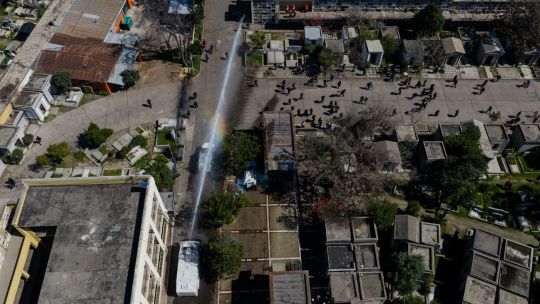
Almost 300 people – including 31 minors – were detained during protests commemorating victims of Augusto Pinochet’s dictatorship. Leer más

Download options
10 Sep 2026, 03:26 GMT Oiwan Lam

‘We cannot allow our young people to become victims of an unjust war of aggression.’ Originally published on Global Voices Representatives from Korean civil society marched from the U.S. Embassy to the Blue House (the executive office and residence of the president of South Korea) in Seoul. Image provided by People's Solidarity for Participatory Democracy in its press release . Used with permission. This post is part of Global Voices’ September 2026 Spotlight series, “ Protest in Democracy .” With this Spotlight, we seek to explore the many forms of protest, the tactics states use to delegitimize and suppress them, and the complex relationship between protest and democracy. You can support this coverage by donating here . Upon Seoul confirming its plan to make a “substantive contribution,” including combat or non-combat military deployment options, to the Strait of Hormuz last week, a coalition of 601 civic groups gathered outside the U.S. Embassy on September 9, 2026, and marched towards the presidential office. The protesters were signaling their opposition to South Korea’s involvement in the Middle East conflict, arguing that the decision would undermine the country’s constitution and sovereignty. Since the United States and Israel launched their joint military action against Iran in early 2026, leading to Iran’s blockade of the Straight of Hormuz, U.S. President Donald Trump has been pressuring allies in Europe and Asia to help reopen the Strait by providing military support. As the U.S.’s November 2026 midterm elections approach, pressure to rally international support for this unpopular war is mounting, and Trump has started squeezing his allies harder . Weeks ahead of the U.S.-Japan-South Korea trilateral military drill , Trump wrote on his Truth Social account that he is scaling down U.S. involvement in the exercise due to Seoul’s reluctance to engage in the Middle East conflict. Washington also announced in early September that it would enact a “targeted, thoughtful tariff policy” on semiconductor imports , clearly targeting Seoul, as South Korea is a major hub for the global semiconductor industry. Soon after this announcement , South Korean domestic media outlets quoted a presidential office official saying Seoul was set to deploy troops to Hormuz by late 2026. While President Lee Jae-myung stressed that the plan was still under review and no final decision had been made , the Ministry of National Defense dispatched a field investigation team to assess the situation in Hormuz on September 7. An imperialist war Since President Lee Jae-myung’s announcement on September 4, Korean civil society has released an outpouring of statements and launched numerous protests. On that day, the Korean Confederation of Trade Unions issued a statement warning against any form of military deployment, arguing that if Korea were coerced into joining the “imperialist war,” it would risk the safety of Korean people and the country’s sovereignty. The Trade Unions also criticized the U.S. for trying to leverage semiconductor tariff negotiations to bargain for military backup, suggesting it was underhanded and unethical. Lee Mu-jin, Executive Committee Chair of the Seoul Candlelight Action, the civic coalition which successfully mobilized for former president Yoon Suk Yeol’s impeachment, also spoke out against the U.S. economic coercion in a public gathering on September 5th, urging officials to defend the country’s sovereignty by rejecting Trump’s demands. Many politicians and political parties issued similarly strong statements against the U.S.’s attempt to drag Seoul into the war with Iran. Both the Green Party and the Justice Party described Trump as a “warmonger,” with the latter raising the following question in a statement on X: 미국 내에서조차 트럼프의 소수 측근만이 옹호하는 이 군사작전에 왜 한국의 시민들이, 청년들이 방패막이가 되어야 하는가. 호르무즈 파병동의안은 “전쟁광 호위동의안”이다. Why should South Korean citizens and young people be used as a human shield for this military operation, while within the U.S. only a handful of Trump’s closest aides support the war? The plan to approve the dispatch of troops to the Strait of Hormuz will serve as a ‘consensus to stand by a warmonger.’ Small-scale protests were seen throughout the weekend. On September 5, People in Solidarity with Palestinians, a civic group composed of students and humanitarian workers, organized an emergency rally against the potential military deployment. “한국군 호르무즈 파병 반대한다!” “이재명 정부는 호르무즈에 한국군 파병 말라!” “No War! No Troops!” https://t.co/3AR1kVUKa2 pic.twitter.com/XmMTTqH5Ev — 팔레스타인인들과 연대하는 사람들(팔연사) (@ppl4pal_kr) September 5, 2026 “We Oppose the Deployment of Korean Troops to Hormuz!” “The Lee Jae-myung Government Must Not Deploy Korean Troops to Hormuz!” “No War! No Troops!” Numerous protests and peace actions took place on university campuses and downtown Seoul on September 7. Meanwhile, Iranian Foreign Ministry spokesman Esmaeil Baqaei wrote in Korean on X, suggesting that South Korea’s military presence in Hormuz would result in “serious consequences,” accompanied by an image reading “dangerous choices come with a price.” On September 9, a coalition of 601 civic groups, the Joint Action Against War of Aggression and Troop Deployment, organized a joint action condemning the U.S. diplomatic coercion. In a statement, the coalition described the U.S. and Israel’s attack on Iran as “an unlawful war of aggression” that violates international law and argued that military deployment to the Middle East will violate the South Korean Constitution, as, according to Article 5, the country should “renounce aggressive war.” The coalition stressed: 우리의 청년들을 부당한 침략전쟁의 희생양으로 내어줄 수는 없다. We cannot allow our young people to sacrifice and become victims of an unjust war of aggression. After stating their positions in front of the U.S. embassy, representatives from the civic coalition marched to the Blue House, the executive office and residence of the president of South Korea. The Seoul government has considered the U.S.-ROK security alliance vital to the country’s survival, as after the Korean War (1950–1953), Korea was divided into the North (backed by the Soviet Union) and the South. Hence, South Korea often stands by the U.S. During both the Vietnam War (1963–1974) and the Iraq War (2003–2008), the South Korean government backed the U.S. with military deployment. However, after the democratic transition, investigative news reports about South Korean soldiers’ involvement in the massacre of Vietnamese civilians have sparked self-reflection and a peacebuilding movement, 미안해요 베트남 (I am sorry, Vietnam), among the progressive NGO sector. Hence, under public pressure, the South Korean government took a non-combatant role during the Iraq War. Faced with U.S. coercion, South Korean civil society has adamantly opposed the country’s military involvement in the Middle East, launching numerous protests and peace campaigns since April. Now, despite the military threat coming from North Korea’s nuclear weapons and missile programs and the country’s oil supply being heavily affected by the closure of the Strait of Hormuz, various polls showed that a slight majority of South Koreans still opposed military deployment to the Middle East. As the Lee administration said that it would seek public consensus over the decision, the anti-war network will continue working to stop the country from being dragged into the Iran war. The next grand mobilization is set for September 12. Written by Oiwan Lam

Download options
8 Sep 2026, 04:48 GMT Susmita Aryal

Many young people left the September 2025 protests in Nepal with scars — both physical, emotional, and financial Originally published on Global Voices Nepal's Gen Z protests against corruption in Bharatpur, south-central Nepal. Image via Wikipedia by Himal Subedi . CC BY-SA 4.0 . This post is part of Global Voices’ September 2026 Spotlight series, “ Protest in Democracy .” With this Spotlight, we seek to explore the many forms of protest, the tactics states use to delegitimize and suppress them, and the complex relationship between protest and democracy. You can support this coverage by donating here . Nepal observed its first Gen-Z Martyrs’ Day on September 8, 2026, with a nationwide public holiday, marking exactly one year since young protesters took to the streets and caused fundamental change throughout Nepal’s social and political system. In September 2025, Nepal was gripped by nationwide protests led largely by students and members of Gen Z . The movement began with the government’s ban on social media platforms , but it quickly grew, without a leader , into a broader expression of public frustration over government corruption and inefficiency. Over several days, young Nepalis took to the streets across the country, protesting not only restrictions on online expression but also corruption, alleged misuse of public funds, and the visible wealth of political elites and their families. The protests then descended into confrontations with police officers that escalated and resulted in unlawful use of force, including severe human rights violations . Liza’s frustrations Among those caught in the violence was Liza Adhikari, 21, who was shot by an SLR bullet while standing opposite the Parliament Secretariat building. The bullet struck her from behind, tore through her body, and exited through the front, leaving behind an injury that cannot simply be stitched away. Liza Adhikari, taken on a stretcher to the National Trauma Center Hospital in Kathmandu—half an hour after she was shot. Image via Liza Adhikari. Used with permission. A final-year Bachelor of Business Administration student at Kathmandu University, Adhikari has not returned to her classes since the incident. She is left to suffer not just the physical damage but an emotional burden as well. She appealed for financial assistance through social media and visited hospitals across Nepal in search of treatment. With limited options available, she eventually traveled to India, where she recently underwent brachial plexus surgery . The brachial plexus is a network of nerves that carries signals from the spinal cord to the shoulder, arm and hand, allowing movement and sensation. In an online interview with the author from a hospital in India, Adhikari told Global Voices that the bullet had severely damaged the bones in her upper arm and doctors had told her that the veins were no longer functioning properly. Her chances of making a full recovery, she was told, remain uncertain. Yet she has not given up. Liza Adhikari, present day, in Mahakali (Sudurpaschim) province of Nepal. Image taken by her mother. Used with permission. That determination is also what brought her to the protest that day — something she now remembers with great loss and regret. The bullet has been removed, but its consequences continue to shape her health and educational path. Liza wasn’t alone on the streets that day. Shantanu’s story Shantanu Dhakal’s survival from Itahari , in the Sunsari District of Koshi Province in Nepal, is yet another example of the lasting consequences of the violence that was no longer confined to the capital. On September 8, 2025, Shantanu was in his college. Little did he know that the day of the protest would become an unexpected turning point in his life. For several days before the demonstration, he had been receiving information about the planned protest through social media. The 18-year-old, an only son born into a middle-class farming family in Morang district of eastern Nepal, joined the protest in Itahari that day. He went with confidence, carrying a banner filled with slogans he had prepared with his friends. “For the first hour, the streets were peaceful. But suddenly, after a while, crowds started marching aggressively, burning and throwing stones at public property and the Metropolitan City ward office. It lasted for two hours. Around four p.m., bullets and tear gas were fired at civilians. When the first bullet was shot, it went somewhere else; nobody knew where. But when the second bullet was fired, I didn’t realize that it was me this time,” he said in an online interview. In a matter of seconds, the protest that Shantanu had joined with confidence became a moment of survival. He regained consciousness about a minute later, after being taken to a nearby clinic where his wound was bandaged. He was then placed on a stretcher and taken to Birat Teaching Hospital. Until then, he remembers, “I had no hearing, no vision, nothing. Perhaps no sensory cells were functioning properly at that time.” Shantanu during the treatment in Biratnagar. Image via Shantanu. Used with permission. His first instinct was to run. That instinct may have saved him from further injury. The bullet entered through the left side of his jaw, fractured the bone around his teeth, and damaged the soft tissue inside his mouth before traveling towards his chest. What followed was not just emergency treatment, but the beginning of a long recovery. He initially underwent a tracheostomy and was kept on a tube to help him breathe. This was later followed by grafting as part of his treatment. For many, an injury may eventually become nothing more than a physical mark. For Shantanu, however, the scar still carries the memory of what happened that day. Even after ten months, it can bring back the trauma. Some days, it triggers regret and painful memories; on others, he learns to make adjustments and live with it. Because ultimately, life goes on. But the consequences of that day do not remain only on his skin. The injury has affected his physical movements, particularly while eating and sleeping, and its effects become even more noticeable when he works in the farm fields. His body has undergone two surgeries, although neither was considered major. Shantanu (standing in front of the PM office in Singhadurbar, Kathmandu. Image by Shantanu. Used with permission. The injury has also brought a financial burden to his family. Medicines prescribed by his surgeons are not always readily available and are expensive. Fortunately, much of his medical treatment has been covered by the Government of Nepal. Not every person who took to the streets was left with bruises on their body, while many have been marked with fear and trauma. Riya's story Riya (name changed), a police constable, also has a similar story. In an in-person interview with the author, she shared that she was on duty in Baneshwor , Kathmandu, on September 8, 2025, with some of her colleagues and friends. “The street was peaceful for the first half an hour, but suddenly it turned violent. Some of my friends were taken away by police, while I was struck by stones, severely bruising my left foot. I was taken to a nearby hospital, and my wound was bandaged,” she said. Riya getting treatment in a clinic. Image by Riya. Used with permission. But the fear continued after she left the hospital. “It was the scariest moment. Even after I returned home, that feeling did not easily go away,” she recalled. On September 8th alone, 19 people died during the protests , with hundreds more injured. But their deaths didn’t end the conversations they stood for. Abhijeet Adhikari, a lawyer and political activist, reflects on that day. Speaking to Global Voices over the phone, he said, “No principle of proportionality was followed,” fueling the public’s demand for accountability. Justice and accountability After the protests led to the installation of an interim government , numerous investigations have sought to determine responsibility and prosecution procedures . A judicial inquiry commission led by Gauri Bahadur Karki recommended the arrest of the leaders involved, including then-Prime Minister, former prime minister (K.P.) Sharma Oli , Home Minister Ramesh Lekhak , and others. However, a separate review panel in July 2026 found that the available evidence was not sufficient to hold them under criminal liability charges. Since then, even after a year, the path towards prosecution has become politically contested, and accountability still remains uncertain. Yet amid all these uncertainties, Liza, Shantanu, and Riya shared their thoughts on the impact of the protests and how the subsequent violence continues to affect them as they marked the anniversary. For Liza, those days remain intertwined with regret and the consequences of a decision she wishes she could undo. “Maybe, if I had listened to my parents that day, this wouldn’t have happened to me,” she said. For Riya, she chose not to remain trapped in the past. “Whatever happened, happened. It’s in the past,” she said. Yet, she remains uncertain about the direction in which the country is heading. While Shantanu grapples with a facial scar, he refuses to allow it to become his future. While he is slowly picking himself up as a recent high school graduate and is busy preparing to pursue an engineering degree. When you look at him, his smile says it all. Perhaps that’s the beauty of every survivor like him. Written by Susmita Aryal

Download options
7 Sep 2026, 06:58 GMT Mong Palatino

Civil society groups are demanding a timeline for when the government will reform the restrictive legislation Originally published on Global Voices Marchers during the Bersih (change) protest in Kuala Lumpur in 2011. Photo by Hafiz Noor Shams, uploaded on Wikipedia, Creative Commons Attribution 3.0 Unported This post is part of Global Voices’ September 2026 Spotlight series, “ Protest in Democracy .” With this Spotlight, we seek to explore the many forms of protest, the tactics states use to delegitimize and suppress them, and the complex relationship between protest and democracy. You can support this coverage by donating here . Human rights advocates are calling on the Malaysian government to amend the Peaceful Assembly Act , which contains several provisions that police and local authorities use to undermine, disrupt, and even criminalize protests and public assemblies. Despite months of promises to amend the controversial provision, the government has continually delayed reforms. The law passed in 2012 and has been weaponized by successive governments to file harassment charges against protest organizers and leaders of civil society groups. After years of condemning the law, civil society groups scored a crucial victory in 2025 when Malaysian Prime Minister Anwar Ibrahim pledged to amend the more extreme sections of the law, particularly Section 11, which requires a property owner’s consent before an assembly or protest is held in a particular place. This was followed by a favorable Federal Court ruling in July 2025, which struck down Section 9(5) of the Peaceful Assembly Act as unconstitutional and invalid. Section 9(5) requires protest organizers to notify the police at least five days before a protest or rally. Failure to do this is considered an offense that authorities often invoke to threaten activists. The court ruling described the section as “a disproportionate intervention” that amounted to a prohibition rather than a restriction on guaranteed rights. The government initially sought to review the ruling, but this was dropped after a Cabinet meeting in January 2026, which meant that the court’s decision remains in effect. Despite the landmark court ruling and the government’s stated commitments, the bid to amend the law has stalled in Parliament over the past year. Police violently broke up a protest in July 2025 near the Parliament building, as demonstrators demanded reform of the “draconian legislation.” Police also tried to prevent protesters from submitting a memorandum for lawmakers against the “oppressive law.” Nalini Elumalai, senior Malaysia program officer at ARTICLE 19, a global human rights watchdog, condemned the police’s actions in a statement: Peaceful assemblies are crucial in bringing to light topics of legitimate public interest. Yet, those who call for accountability, including the reform of archaic laws that are not in line with international standards, are often repressed or silenced. Authorities continued to invoke the law to threaten protest organizers, which led the Human Rights Commission of Malaysia (SUHAKAM) to issue a reminder in February 2026 addressed to law enforcement bodies. SUHAKAM notes that the Peaceful Assembly Act (PAA) 2012 places responsibilities on the authorities, including the police, to manage assemblies in a lawful, proportionate and facilitative manner. Any enforcement action taken should be grounded in clear legal authority, respect due process, and be appropriate to the circumstances. In April 2026, Amnesty International Malaysia expressed dismay over the lack of any meaningful action to amend the law. More than a year on, there has been no substantive overhaul of the law. Instead, authorities have continued to rely on its repressive provisions, alongside the Penal Code and Minor Offences Act, to investigate and intimidate protesters. Announcements of reform alone are not enough, as people are still being arrested, investigated, and intimidated for speaking out. The government must urgently amend the Peaceful Assembly Act as it has promised, ensuring it is in line with international human rights law. Amnesty International Malaysia’s spokesperson Divya Shesshsan Balakrishnan noted that anti-corruption activists and student protesters continue to be slapped with charges for organizing protests. He added that Malaysia’s global stance on human rights is often inconsistent with its local actions. For example, she argued that though the Malaysian government has been criticizing Israel’s attacks on the Palestinian people, it also ordered the arrest of some individuals who protested Israel’s interception of the Global Sumud Flotilla. In August 2026, civil society groups urged Malaysia’s Parliament to present a clear timeline for reforming the Peaceful Assembly Act. In a press conference, Bersih advocacy officer Anas Nor’azim summed up the sentiments of human rights advocates. “The same promise continues to be repeated, but the long-awaited reform remains stuck in the study phase.” Written by Mong Palatino

Download options
25 Aug 2026, 18:58 GMT Liam Anderson

Capulanas, protests, and social media reveal new forms of women's resistance and digital activism in Mozambique. Originally published on Global Voices A stack of capulanas. Photo taken by Wyte Shot. Accra, Ghana. Via Pexels . Pexels license . Days before April 7 , Mozambican Women’s Day, women protestors took to the streets of Nampula city protesting over Mozambiquan first lady Gueta Chapo’s failure to deliver on promises to give out capulanas (colorful dresses popular in Mozambique) in celebration of the date. This is reminiscent of political protests following the 2024 general elections , when demonstrators took to the streets and women — many wearing capulanas — visibly stood out amid intensifying confrontations with police and roadblocks. Similar demonstrations occurred in Anchilo after the first lady announced she had no capulanas to offer . Two people were wounded by bullets during the confrontation. Capulana: From cultural symbol to tool of resistance The capulana is central to Mozambiquan cultural identity and is a staple for many women. However, this garment gained new significance amid the protests in Nampula. Beyond mere clothing, protesters used it as improvised protection against tear gas, and it became a visual symbol of unity and resistance, building on its earlier association with women’s participation in the national liberation struggle and, in turn, with the image of independence activist Josina Machel . The use of culturally significant objects in protests is not new. Studies in African contexts show how traditional fabrics and symbols can take on political importance during crises and demonstrations. The growing number of women protesters reflects an upward trend of female participation in civic life in Mozambique. Organizations such as Amnesty International and Human Rights Watch have documented risks faced by protesters, including excessive use of force, arbitrary arrests, and intimidation — with varying impacts on women and young people. An activist who asked not to be identified told Global Voices, “ Women are no longer just observers. They are part of the movement.” Tension at a national level The recent events in Nampula are linked to a broader instability that has followed the 2024 general election, during which, according to the platform Decide , thousands of people were arrested, and hundreds died in related events. In addition, organizations such as the Center for Public Integrity are alerted to election irregularities and breaches of transparency. Digital space and protest visibility Much of the documentation of the protests in Nampula was shared online. This shows how social media has become a central tool for reporting abuse, mobilizing citizens, and sharing evidence in real time. However, organizations such as Access Now and CIPESA (The Collaboration on International Policy for East and Southern Africa) have warned of the risks of restricting internet access during times of political upheaval. While Mozambique has not restricted internet access thus far, with the approval of Decree No. 48/2025 on December 16, 2025 , officials established control mechanisms that would allow them to block access to the country’s telecommunications networks. Officials have also proposed a new Highway Code that penalizes those who block public roads during protests. The draft was made available to the public for comment. This situation raises lines of analysis and questions, such as: How is the use of social media redefining digital activism and citizen documentation in Mozambique, especially in contexts of protest and political tension? What is the possibility of growth for alternative forms of digital mobilization, decentralization of information, and use of encrypted platforms in contexts of greater state control, and what comparisons can be made with other African countries, where internet blocks have been used during protests, elections, or political crises? Written (Português) by Tirso Sitoe Translated (English) by Liam Anderson View original post (Português)

Download options
18 Aug 2026, 06:06 GMT Laura

In the eastern Democratic Republic of the Congo (DRC), an armed group known as the M23 imposes its authority on local communities. But what is the history behind this movement?

Global Voices logo
Video
Credit: Laura
18 Aug 2026, 06:06 GMT Laura

In the eastern Democratic Republic of the Congo (DRC), an armed group known as the M23 imposes its authority on local communities. But what is the history behind this movement?

Global Voices logo
Video
Credit: Laura
18 Aug 2026, 06:06 GMT Laura

In the eastern Democratic Republic of the Congo (DRC), an armed group known as the M23 imposes its authority on local communities. But what is the history behind this movement?

Global Voices logo
Video
Credit: Laura
18 Aug 2026, 06:06 GMT Laura

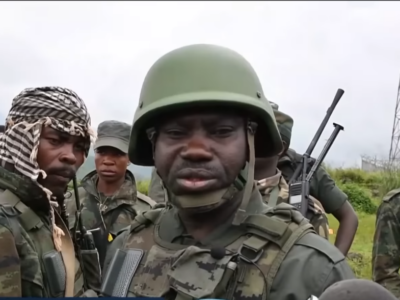
Instability in North Kivu, DRC, has significant impacts on the country’s political future Originally published on Global Voices M23 rebels during the Kibumba withdrawal. Screenshot the video “M23 Rebels Withdraw from Kibumba” on the TV5Monde YouTube Channel. Editor’s note: Since Jean Sovon first published this article on November 24, 2023, incumbent President Félix Tshisekedi was re-elected with 73 percent of the vote in the December 20, 2023 elections. The conflict has also worsened. In early 2025, M23 rebels launched new offensives, taking complete control of Goma and Bukavu, the capitals of North and South Kivu, pushing the number of internally displaced persons above 7 million. In the eastern Democratic Republic of the Congo (DRC), an armed group known as the March 23 Movement (M23) imposes its authority on local communities through violence, sexual assault , and terror. But what is the history behind this movement? And what impact did its offensives have on the December 2023 general elections? What is the M23? The M23 emerged from renewed tensions following the Kivu Conflict . This localized conflict in the eastern DRC, along the border with Rwanda, began in 2004. The Armed Forces of the Democratic Republic of the Congo (FARDC) faced opposition from several armed groups. These groups included the National Congress for the Defense of the People (CNDP), founded in 2006 by the politician and Tutsi militia leader Laurent Nkunda. The DRC is a multi-ethnic country , and the Tutsis are an ethnic group primarily living in the Kivu region. After five years of conflict, the DR Congolese state and the CNDP signed a peace agreement on March 23, 2009. Under the agreement, the rebel group agreed to transform into a political party in exchange for the release of its imprisoned members, improved living conditions for Tutsi communities, and three ministerial posts in government after the 2011 presidential election . The DRC authorities’ failure to comply with the agreement terms led former CNDP rebels, who had integrated into the national Congolese army under the peace agreement, to revolt. In April 2012, they consequently formed the M23 to mark the agreement signing date, March 23, 2009 . This TV5Monde report explains the origins of this movement: The rebel movement thereby resumed its armed campaign. According to officials in Kinshasa, the DRC capital, both Rwanda and Uganda supported the M23. Both countries, however, denied any involvement. An anonymous DR Congolese officer, who was involved in the 2013 conflict, explained further in this article by online media outlet Afrique XXI : Kigali niait, mais nous,au front, il nous arrivait de capturer des combattants rwandais ou des soldats du M23 qui étaient passés par le Rwanda, explique, sous le couvert de l’anonymat, un gradé congolais ayant pris part au conflit en 2013. Le message, c’était d’anéantir le M23, point! Il ne s’agissait absolument pas de mener la guerre jusqu’au Rwanda, même si, avec les informations qu’on avait, on savait parfaitement d’où et de qui venait cette guerre. Le Rwanda est dirigé par des Tutsi, le M23 est une mutinerie de soldats congolais tutsi, ils sont frères et parlent la même langue, ils avaient même souvent des liens familiaux au Rwanda. Kigali, the capital of Rwanda, denied everything, but on the frontline, we would often capture Rwandan fighters or M23 soldiers who had passed through Rwanda. Our orders were to wipe out the M23, period! Although we knew perfectly well who was behind this war and where it came from, based on the information we had, taking the war to Rwanda was never our intention. Tutsis lead Rwanda, and the M23 is a mutiny of Congolese Tutsi soldiers. They are brothers who speak the same language and often have family connections in Rwanda. Four years after signing the peace agreement, the M23 rebellion appeared to end. Backed by UN peacekeepers, on November 5, 2013, the FARDC won a historic victory against M23 troops. Silenced, they fled to neighboring countries, such as Uganda and Rwanda . This video provides a detailed overview of the FARDC victory: M23 makes a comeback However, in March 2022, almost a decade after its defeat, the M23 made a military comeback. According to UN experts , with Rwanda’s ongoing support, the movement took up arms once again in the region, launching offensives against the DR Congolese army’s strategic positions. The motivation behind this resurgence remained unchanged: The DRC authorities’ failure to comply with the 2009 peace agreement. On March 25, 2022, Bertrand Bisimwa , the current M23 leader, explained his desire to avoid another war on X: Nous avons tout fait pour éviter une nouvelle guerre dans ce pays. Cependant le gouvernement congolais a fait ses choix. pic.twitter.com/LoKwZYSaPM — Bertrand Bisimwa (@bbisimwa) March 25, 2022 We have done everything to avoid another war in this country. However, the DR Congolese government has made its choices. pic.twitter.com/LoKwZYSaPM — Bertrand Bisimwa (@bbisimwa) March 25, 2022 The text in the picture reads: The violence currently inflicted upon us by the Congolese army (FARDC) in the Rutshuru territory is a deliberate choice by the government. The state has chosen to wage war against citizens who surrendered unconditionally. We did this in response to the President’s appeal at the start of his term [DRC President Félix Tshisekedi’s January 2019 inaguration address], calling on the country’s sons and daughters to unite and rebuild the nation. In response, our organization sent several letters to the President of the Republic and the Coordinator of the National Monitoring Mechanism of the Addis Ababa Framework Agreement (MNS). In these documents, we offered our unconditional surrender and put ourselves at the Head of State’s service. Subsequently, on our own initiative, we sent delegates to Kinshasa to speed up this surrender. Copies of these letters are attached to this press release: Letter from January 26, 2019: Sent to the President, congratulating him on taking office. Our movement offered its full support, backing his national reconciliation program and helping bring peace to eastern DRC. Explanatory Note from March 9, 2019: Sent to the President regarding the peace process stemming from the Nairobi Declarations of December 12, 2013. Letter from June 15, 2019: Sent to the newly appointed Coordinator of the National Monitoring Mechanism of the Addis Ababa Framework Agreement (MNS), Mr. Claude Ibalanky Ekolomba, requesting updates on the 2013 peace declarations signed between the DRC government and the M23. Letter from July 12, 2019: Sent to the Coordinator of the National Monitoring Mechanism of the Addis Ababa Framework Agreement (MNS), expressing our full support for the 2017 Brazzaville regional agreement, specifically regarding plans to return M23 fighters home unconditionally. Letter from September 21, 2020: Sent to the President to once again confirm ou surrender and verify that all M23 political and military personnel were following his orders. Mission Order from September 30, 2020: After receiving no response to our letters, our movement sent a delegation to Kinshasa to speed up the surrender process. Our delegates remained in Kinshasa for 14 months. They held multiple working sessions with state authorities, who eventually told them to return to their base and wait for the surrender operations to begin. Much to our surprise, just two weeks later, the FARDC launched an offensive, putting our fighters on the defensive. Official Record from October 24, 2020: Documenting the formal recognition of the General Staff of the Congolese Revolutionary Army. Letter from February 12, 2021: Following the Kinshasa meetings, the Deputy Prime Minister and Minister of the Interior, Mr. Gilbert Kankonde, wrote to the President, informing him of a complete M23 stand-down. He requested funds to execute the disarmament operation, but to no avail. The military operations that the national army has launched against our fighters clearly show that the government has chosen to fight the M23 rather than accept our unconditional surrender. Our organization has been tirelessly awaiting the implementation of the peace process for nine years. We deeply deplore this choice of violence, whose hidden objective is to maintain instability and underdevelopment in eastern DRC. Signed in Sarambwe on March 25, 2022 By the March 23 Movement Willy NGOMA Spokesperson for the Congolese Revolutionary Army Interviewed by TV5Monde in April 2022, Pierre Boisselet , Violence Research Director at Ebuteli, a Congolese research institute , elaborated further on the M23 comeback: Far from weakened, the M23 gained territory and expanded its influence in North Kivu a year after the renewed hostilities. This was a major setback for the Kinshasa government, which sought to regain and secure these territories ahead of the upcoming general elections. Instability risks during elections In late December 2023, as the DRC prepared to hold its general elections, the electoral roll revision process went smoothly throughout the country. However, voter enrollment was extremely challenging in the east, prompting some political figures and civil society organizations to request an extension in these areas. Read more: General election preparations continue despite growing insecurity in DRC. During the electoral process, the M23 comeback had a major impact, including increasing insecurity in the province with the second-largest voter count. Forced to flee, the number of internally displaced persons continues to increase in the DRC. Quoted in a TV5Monde article on November 19, 2023, the United Nations Office for the Coordination of Humanitarian Affairs (OCHA) reported: La reprise des combats début octobre a déjà fait plus de 450 000 déplacés supplémentaire. Les provinces du Nord-Kivu, du Sud-Kivu et de l’Ituri abritent à elles seules plus de 5,5 millions de personnes déplacées. The renewed hostilities, beginning in October, have already displaced an additional 450,000 people. The North Kivu, South Kivu, and Ituri provinces alone host more than 5.5 million displaced persons. In addition to the M23, other rebel groups also operate in the same region. These include the Allied Democratic Forces (ADF), a predominantly Muslim group affiliated with the Islamic State, which often attacks civilians. Another is the Cooperative for the Development of Congo (CODECO), a group committed to protecting the Lendu community from the Hema ethnic group and FARDC in the northeastern Ituri Province . Lastly is the rebel branch of the Burundian National Forces of Liberation (FNL), based in the Mwenga Territory , South Kivu Province . These groups, therefore, pose a security challenge for the Kinshasa government, which has yet to find a solution to the M23 rebellion. The general elections on December 20, 2023, were ultimately held amid high tensions and escalating violence throughout the region. According to Bob Kabamba, Professor of Political Sciences at the University of Liège, the risk of spillover effects was not limited to the DRC’s borders . In a TV5Monde interview, he warned: Il faut souligner l’inquiétude de toute la région : l’est de la RDC, l’Afrique centrale, la Communauté de développement d'Afrique australe… tous tirent la sonnette d’alarme sur la situation au Congo, sur la persistance d’une insécurité qui pourrait impacter d’autres pays comme le Congo Brazzaville, la République centrafricaine et le Sud Soudan si le Congo se trouvait déstabilisé. We must highlight the concerns felt across the region. For eastern DRC, Central Africa, and the Southern African Development Community (SADC), alarm bells are ringing about the situation in the Congo and its ongoing insecurity. If the Congo were to become destabilized, this could ultimately impact other countries, such as Congo-Brazzaville, the Central African Republic, and South Sudan. Written (Français) by Jean Sovon Translated (English) by Laura View original post (Français)

Download options
19 May 2025, 15:00 GMT Guest Contributor

“I don’t think that the government is doing enough, I think more should be done in the case of gender-based violence…” Originally published on Global Voices Screenshot of a protester holding a placard from YouTube video, ‘ SOUTH AFRICA : Outrage over alleged rape of 7 year old sparks protests against gender based violence’ by Carrefour medias télévision . Fair use. Content notice: This article contains descriptions of assault and gender-based violence that some readers may find disturbing. By Christianah Lumsden Over 2,000 people marched in Pretoria, South Africa, in early April, demanding government action against ongoing violence towards women and girls in the country. The protests were sparked by the alleged rape of a seven-year-old girl at her school last year in Matatiele , and femicide in Bredasdorp. The young girl, referred to as Cwecwe to protect her identity, became a symbol of public outrage, with thousands gathering in Cape Town to protest . The anger intensified when it was revealed that her mother reported the sexual assault a month after it happened, expressing deep disappointment in the justice system she felt had failed her . The current Miss South Africa, Mia Le Roux , was among the protesters urging the government to do more to uphold the rights of women and girls, especially in the context of abuse. One of the protestors, student activist Nombulelo Chiya, said during an interview : I don’t think that the government is doing enough, I think more should be done in the case of gender-based violence because as I’m speaking to you right now there is currently a woman who’s being raped. There’s currently a child being abused or raped and we’re just chilling and also not speaking up, as if it is a thing that just happens once in a while. According to a recent documentary “Small Town Safe House” by Al Jazeera , several instances of rape and murder in Bredasdorp, South Africa have occurred in the last few years, causing widespread distress and fear among its 15,000 inhabitants. This Black and mixed-race community is also disproportionately affected by societal problems such as extreme poverty, family fractures, drug addiction, and domestic violence. Many women are unable to care for themselves or their children. Some of these children are unable to break the cycle of abuse and poverty, left traumatized and unable to escape the dire conditions they face. Lana O’Neill, a community outreach worker, faces an uphill battle in securing funding from the corrupt government to help these marginalized groups. She tells of one incident which deeply affected her and further scarred the community: Jodene Pieters, a 17-year-old teenager who was raped. Afterward, the perpetrators set fire to her body, which was then thrown into a pit. Jodene’s body was unrecognizable except for a distinctive mark on her leg. African Union leaders strive to protect women and girls At the African Union Summit held in Addis Ababa, Ethiopia, in February 2025, all member states adopted the AU Convention on Ending Violence Against Women and Girls (AU CEVAWG). As noted by Every Woman Treaty , this new Convention is a major step in strengthening women’s rights and protecting women and girls on the continent. Every Woman Treaty explains that limiting gender-based violence and advancing legal frameworks that ensure justice and accountability for all forms of gender-based violence are crucial in attaining overall gender equality. Aisha Simon, Board Chair of Every Woman Treaty, spoke in support of this law, as well as a new Optional Protocol to the Convention on the Elimination of All Forms of Discrimination Against Women ( CEDAW ), a complementary piece of legislation meant to stop violence against women and girls . According to Every Woman , this framework will change social norms and attempt to lower rates of violence and create safer environments where women and girls can live to their full potential. There has been a growing trend in violence against women and girls in Africa since 2023, prompting concern from the UN Women's Organisation. Sima Bahous , UN Women Executive Director, said such violence is preventable through robust legislation, so that governments are held responsible. The 30th anniversary of the Beijing Declaration and Platform for Action in 2025 will further enhance the urgency for world leaders to recommit to ending femicide and violence against women and girls. Where does South Africa go from here? The violence and sexual assault cases have not gone unnoticed. Nobunto Hlazo-Webster, deputy leader of Build One SA , urged the South African government to intervene. She noted: We are here to say that the way the justice system works in this country is not conducive to curbing and actually killing the gender-based violence and femicide crisis that we have. She demands that the government publish a National Registry for Sex Offenders that gets updated regularly. She also noted that educators should be screened against this database to deter would-be offenders in schools. The government has introduced legislation that would ensure the safety and protection of women and children from abuse and violence. The National Council on Gender-Based Violence and Femicide Bill and the National Prosecuting Authority Amendment Bill were signed into law in May 2024 to offer leadership guidance to fight gender-based violence against women and children in a proactive approach. As the country reached the milestone of 30 years of democracy, President Matamela Cyril Ramaphosa signed both bills into law and said : “Corruption and gender-based violence are affronts to the human dignity that is the inalienable right of every South African. These forms of criminality are holding our country back and preventing us from realising our full potential.” In a Presidential state of the nation address in February 2024, President Ramaphosa spoke of the long 30-year journey to “achieve a new society” that is democratic, although as a nation, South Africa has “endured times of great difficulty, when the strength of our constitutional democracy has been severely tested.” In his inaugural speech on May 10, 1994, President Nelson Mandela said: Our daily deeds as ordinary South Africans must …reinforce humanity’s belief in justice, strengthen its confidence in the nobility of the human soul. President Mandela’s wish was for the international community to get involved in supporting the rights of the historically marginalized. He said: We trust that you will continue to stand by us as we tackle the challenges of building peace, non-sexism, non-racism, and democracy. Although there has been some progress towards addressing these challenges , the fight against gender-based violence cannot succeed unless South Africans — and the global community that supports the visions of Presidents Ramaphosa and Mandela — stand united in seeking justice alongside the families of Cwecwe and Jodene. Written by Guest Contributor

Download options